
The Most Expensive Employee in Your Company Is the One You Never Hired

Walk into almost any growing business in America and you'll find the same ghost on the payroll.
You won't see them at standups. They don't have a desk. But they're costing you more than your top salesperson, your operations lead, and your marketing manager combined. They're the reason you're up at 1 a.m. on Sunday squinting at QuickBooks. They're the reason your last three big decisions were made on gut feel instead of numbers. They're the reason your banker keeps asking for "updated financials" and you keep stalling.
This ghost employee is your missing finance function. And until 2024, fixing it was a math problem most growing businesses couldn't solve. Bookkeepers were too junior. CFOCFO/Controller Level s were too expensive. DIY software left you doing the work yourself. So most owners did nothing — and the ghost kept billing them, silently, every single month.
Then AI changed the math entirely. And we built our firm around it.
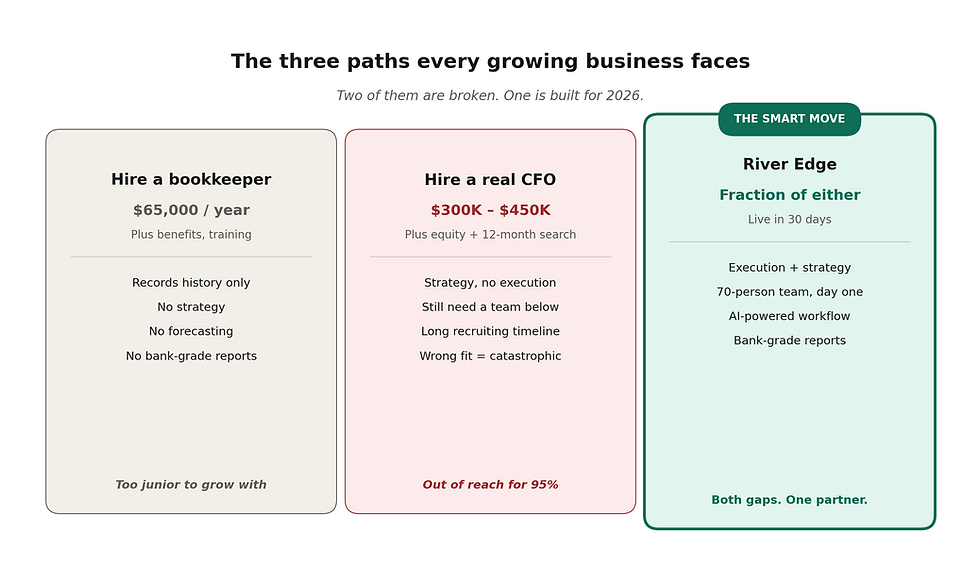
The Three Paths Every Growing Business Faces
Most owners think they have three options for handling their finances. All three are broken in different ways.
Option 1: Hire a bookkeeper for $65,000 a year. They'll record what already happened. They can't tell you why your gross margin dropped 4 points. They can't sit across from your banker and defend your inventory line. They can't restructure your chart of accounts so your P&L actually shows you how your business makes money. You don't need someone to record history. You need someone who can read the numbers and tell you what to do next.
Option 2: Hire a real CFO for $300,000 to $450,000 a year. Plus benefits. Plus equity. Plus the year it'll take you to find one who's actually good. For 95% of growing businesses, that math doesn't work. So they don't hire one. And the ghost employee keeps costing them money.
Option 3: DIY with software. Now you're the most expensive bookkeeper in America, doing $15-an-hour work when you should be doing $500-an-hour work closing deals and growing the business.
There's a fourth option most business owners don't know exists. That's where we come in.
How AI Quietly Rewrote the Economics of Finance
Here's what most business owners don't realize: the reason hiring a real CFO used to cost $400,000 wasn't the CFO. It was the team they needed underneath them — bookkeepers, AP clerks, AR specialists, controllers — to generate the numbers the CFO would interpret. The strategist was 20% of the cost. The execution layer was 80%.
AI just collapsed that bottom 80%. Bank feeds categorize themselves. Invoices get matched in seconds, not hours. Receipts get captured, coded, and filed before a human even looks at them. Reconciliations that used to eat half a junior bookkeeper's week now run overnight.
This is not a "future of work" theory. This is what's running inside our firm right now.
But here's the part most outsourced firms get wrong: AI is a force multiplier, not a replacement. It's terrific at the boring 70% — and dangerous at the strategic 30%.
AI can't tell you that the "consulting expense" your sales VP just expensed is actually a kickback. It can't notice that your gross margin dropped 4 points because procurement quietly switched to a more expensive supplier. It can't sit across from your banker and defend your inventory line. It can't tell you to pause distributions because cash gets tight in 60 days.
That's judgment. That's experience. That's the part of finance that determines whether your business sells for $2 million or $20 million when you eventually exit.
So we built the firm around that split. AI runs the floor. Senior humans run the strategy. You get both.

What This Means for the Number on Your Invoice
Let's stop being abstract.
A traditional outsourced firm — one still doing reconciliations by hand, still typing invoices into QuickBooks one at a time — has to charge you for every one of those hours. A firm built for the AI era doesn't. We pass that savings on, and we redirect the time to the work that actually matters: a senior controller looking at your numbers, a fractional CFO building your forecast, a partner answering your banker's call before it becomes a crisis.
This is why our clients consistently tell us they're paying less than they were paying in-house — and getting a senior team they couldn't afford to hire on their own.

What We Actually Do
River Edge Advisors is not a bookkeeping service. We're not a fractional CFO firm in the usual sense either. We're something most business owners didn't know existed until they met us:
We are your entire finance department, AI-powered, on day one, for a fraction of what hiring it would cost.
Seventy people. Bookkeepers, controllers, AP specialists, AR specialists, fractional CFOs — the whole stack, working together as one team that plugs into your business like they've been there for years. AI handles the routine work in the background. Senior humans handle the work that decides whether your business wins or loses.
When our clients call their banker, the banker calls us back. When the IRS sends a notice, we handle it before our client even sees it. When a vendor disputes a payment, it's resolved by the time the CEO hears about it. When the board wants a forecast, we have one ready — built on numbers that closed yesterday, not last quarter.
That's not bookkeeping. That's not advisory. That's a finance department running while you sleep, powered by tools that didn't exist three years ago.
What Happens in the First 90 Days
Let me tell you what happens when our clients hire us. Not in vague language — in specifics, because you deserve specifics.

Day 30: Books current. Reconciliations clean. Chart of accounts rebuilt. AI rips through the historical mess. Books that were three months behind get current. Reconciliations that took weeks now close in days. The chart of accounts that's been a tangled inheritance from three previous bookkeepers gets rebuilt to actually reflect how your business operates. Clients tell us, "Finally, I trust the numbers."
Day 60: Reports that mean something. Not just a P&L — margin by product line, by customer, by salesperson. Cash flow forecasts that go out 13 weeks. Variance analysis that tells you where you're bleeding and where you're winning. The kind of information that, the moment you see it, you wonder how you ever ran the business without it. Clients tell us, "I see things I never saw before."
Day 90: Different decisions. You raise prices on the customers you were quietly losing money on. You stop a hire you were about to make because the cash flow forecast showed it was premature. You walk into a bank meeting with a forecast model that gets you a better rate than you've ever had. You start sleeping through the night. Clients tell us, "Best decision I made all year."
This is not theoretical. This is the standard playbook we run, with a 70-person team that's done it hundreds of times — now moving faster than ever because AI handles the mechanical work while our people do the thinking.
The Real Cost of Waiting
Every month you delay, you pay the ghost employee. We see it constantly:
The client who came to us after a deal fell through because their books couldn't survive due diligence. The one who got declined for a $2 million line of credit because their financials were six months stale. The one who realized — three years too late — that one of their "best" product lines had been losing money the entire time. The one who paid $180,000 in penalties because nobody was watching the sales tax filings.
None of these were small businesses. They were profitable, growing companies with great products and good teams. They just didn't have a real finance function. And it cost them more — sometimes catastrophically more — than ours ever would have.
Why Now, Why Us
Here's the truth nobody else in this industry will say out loud: most outsourced accounting firms are about to be in serious trouble. They built their pricing on hours of human labor. AI just made those hours five times faster. Firms that don't restructure their workflow can't compete on price, and firms that just adopted AI without a senior strategic layer can't compete on value.
We built River Edge for this exact moment. AI in our workflow. Senior humans on every account. Seventy people who've been through three downturns, hundreds of audits, and thousands of bank meetings. Decades of judgment, accelerated by tools that didn't exist three years ago.
When you hire us, you're not getting a junior bookkeeper learning on your dime. You're getting a controller who's seen your industry. A CFO who's been through the exact growth stage you're entering. An AP team that's already negotiated with the kinds of vendors you work with. A team that's still going to be there in five years when your business looks completely different.
That's not an outsourced accounting firm. That's a competitive advantage.
The Conversation Worth Having
If you're reading this and thinking about your own books, your own forecasts, your own back office — that itch you feel is the ghost employee. It's been costing you for a while. It's probably costing you right now.
The good news: figuring out exactly how much, and exactly what to do about it, takes one conversation. We do free assessments — no pitch, no pressure, no obligation — for businesses we think we can genuinely help. You'll walk out of that conversation knowing more about your finance function than you did walking in, whether you hire us or not.
Most of the people who take that meeting end up working with us. Not because we sold them — but because once they see what AI plus a senior human team can do for their numbers, they can't unsee it.
The ghost employee is on your payroll either way. The only question is whether you want to keep paying it, or replace it with the most efficient, most strategic, most powerful finance function your business has ever had.
Reach out at sales@riveredgeadvisors.com or call (516) 548-1622. The first conversation is on us — and worth more than most paid ones.


Comments